



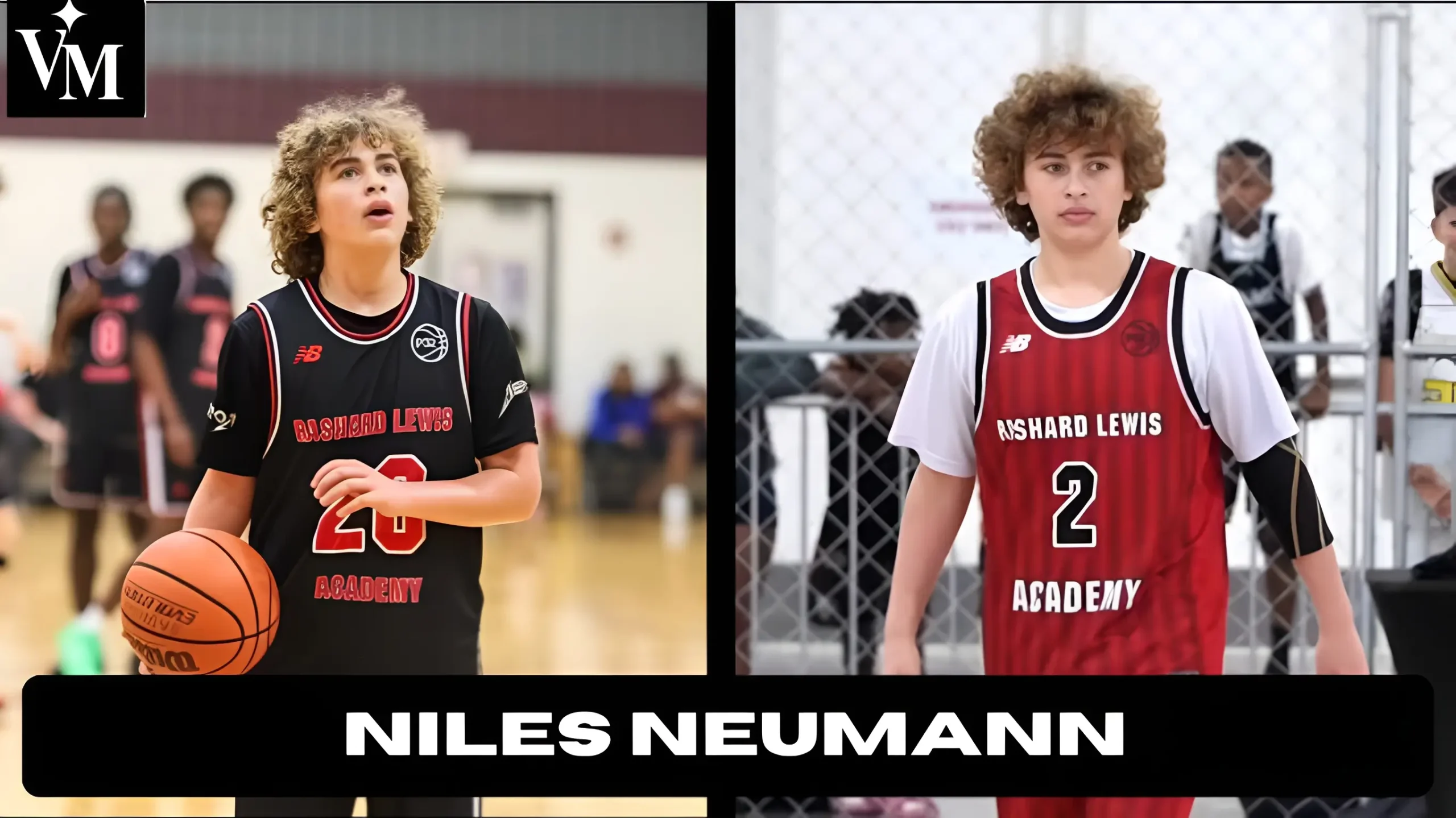
The basketball world has seen its share of young phenoms, but few enter the national consciousness with the velocity and impact of Niles Neumann. At just 15 years old, this Houston-based guard has managed to accomplish what takes many elite athletes a decade or more to achieve: widespread recognition across multiple platforms, respect from college and professional circles, and a blueprint for success that has fundamentally shifted how young athletes approach their careers in the social media age.
Niles Neumann represents a unique convergence of athletic excellence and modern content creation savvy. He’s not simply a talented basketball player—he’s a brand, a content creator, and a case study in how young athletes can leverage digital platforms to accelerate their path to elite competitions and opportunities. With over 1.6 million followers across social media platforms including YouTube, Instagram, TikTok, and Snapchat, Neumann has demonstrated that the traditional pathway to basketball prominence is being rewritten in real-time.
This article explores the multifaceted story of Niles Neumann, breaking down the elements that have contributed to his meteoric rise, the technical and mental attributes that separate him from his peers, and what his trajectory tells us about the future of young talent development in an increasingly digitized world.
Understanding the Niles Neumann Phenomenon
The Social Media Game-Changer
When discussing Niles Neumann, it’s impossible to separate his athletic achievements from his digital presence. Unlike previous generations of basketball prospects who primarily gained attention through AAU circuits and scout evaluations, Neumann has weaponized social media platforms to create a continuous narrative around his basketball journey.
His “Day in the Life” YouTube series provides viewers with behind-the-scenes access to his training regimen, dietary choices, and mental preparation strategies. This transparency serves multiple purposes. First, it builds an authentic connection with his growing audience—fans feel invested in his journey because they’re witnessing the day-to-day grind behind the athletic performance. Second, it creates a documentary-style record of his development that can be referenced and analyzed by coaches, scouts, and competitive peers.
The strategic use of TikTok and Instagram Reels has allowed Neumann to reach audiences that traditional basketball media simply cannot access. A 15-second clip of an impossible floater or a behind-the-back crossover can generate hundreds of thousands of views, each one representing a potential future fan, collaborator, or opportunity. This viral amplification effect has created a feedback loop where his performances on the court directly translate into increased social media engagement, which in turn amplifies his visibility to recruiting programs and professional organizations.
Snapchat, while often overlooked by brand strategists, has served as Neumann’s more intimate platform—a space where he shares unfiltered moments that humanize him beyond the basketball court. This multi-platform approach demonstrates sophisticated digital literacy that many adult influencers struggle to achieve, let alone teenagers.
The “Baby Steph Curry” Brand Identity
The nickname “Baby Steph Curry” didn’t emerge randomly. It’s a direct reference to Neumann’s most defining characteristic: his ability to shoot three-pointers from distances that defy conventional basketball logic. In an era where the three-point line has become increasingly central to basketball strategy, Neumann has taken this evolution to an extreme.
His release is notoriously quick—a blur of motion that gives defenders virtually no opportunity to contest. Combined with his deep range, this creates a mathematical problem for opposing defenses. Teams simply cannot allow Neumann space to operate, yet his ability to create off the dribble means that aggressive defense often results in blown-by drives or open cutting opportunities for teammates.
This skillset parallels Steph Curry’s evolution as a player, which is why the comparison resonates. However, it’s important to note that Neumann is developing his own identity rather than simply mirroring Curry. His creativity in the mid-range, his willingness to attack the basket, and his playmaking ability suggest that his ceiling may extend beyond even the Curry comparisons.
Playing Up: The Competitive Advantage
Dominating Against Older Competition
One of the most significant indicators of Niles Neumann’s elite status is his consistent success when “playing up”—competing against athletes significantly older than him. This isn’t a novelty act; it’s a systematic pattern across multiple elite circuits and tournaments.
In circuits like the New Balance RL9 Academy and the 3SSB circuit, Neumann regularly faces high school players two to three years his senior. In some instances, he’s competing against seniors on their way to Division I programs—athletes who are physically more developed, experienced in high-level competition, and operating with much higher basketball IQs. Yet consistently, Neumann holds his own, and frequently dominates these matchups.
This competitive pattern serves as a crucial data point for evaluating his trajectory. When a 15-year-old outperforms 17 and 18-year-old players at elite levels, it suggests that his athleticism and skill translate across age groups. It indicates that his development curve is steep and that he’s not benefiting from being one of the oldest players in his peer group—a common scenario for young prodigies.
The psychological component of this achievement cannot be understated. Playing up against older, bigger, stronger competition builds confidence and mental toughness that develops differently than dominating peers of the same age. Neumann is learning at age 15 how to solve problems against elite defenders, how to maintain confidence when physically overmatched, and how to execute under pressure against players with more experience.
Case Study: The University of St. Thomas Performance
Perhaps the most tangible evidence of Neumann’s readiness for high-level competition came when he scored 28 points against college players from the University of St. Thomas Houston. While St. Thomas is not a major power-conference program, this performance carries significant weight for several reasons.
First, the competition level represents a material jump from even elite high school basketball. College players, regardless of program tier, have refined their craft over years of collegiate development and are operating within systems designed by experienced coaching staffs. They understand spacing, rotation principles, and team defense in ways that even the most talented high schoolers do not.
Second, a 28-point performance in a scrimmage setting against college competition at age 15 creates a precedent. It establishes that Neumann isn’t merely a high school basketball player; he’s operating in a tier where college basketball becomes relevant to his development. This single performance opens conversations with Division I programs years earlier than the typical recruiting timeline.
Third, this type of performance generates momentum. It becomes a reference point in conversations between coaches, scouts, and influencers. It’s cited in recruiting profiles, discussed in basketball forums, and used as evidence when making the case that Neumann is ahead of the typical developmental curve.
The 86-Point Game and Statistical Extremes
Breaking Scoring Records
Niles Neumann’s 86-point individual game and his 232-point output across 8 games at the Balling On The Beach tournament represent statistical performances that exist at the extreme end of basketball achievement. These aren’t merely impressive stats; they’re data points that inform questions about his ceiling as a player.
An 86-point game in any competitive setting is extraordinarily rare. Even when accounting for tournament play, which typically features more free-flowing offenses and less sophisticated defenses than regular season competition, an 86-point individual performance indicates an extraordinary combination of scoring ability, conditioning, and confidence.
Several factors make these performances significant:
Offensive Versatility: To score 86 points in a single game, a player must score from multiple areas of the floor. Neumann’s ability to hit three-pointers from logo range, create mid-range opportunities off the dribble, and finish at the rim suggests that defending him requires a multi-layered approach—one that elite defenses struggle to execute, and younger competition cannot coordinate.
Conditioning and Basketball IQ: The ability to maintain scoring efficiency across an entire game, particularly one where he’s clearly being hunted by his team’s offense, suggests that Neumann understands how to manage his energy and read the game’s flow. He’s not expending energy on poor shot selections; he’s being selective and efficient within the context of high-volume scoring.
Psychological Resilience: Scoring at this volume requires confidence that borders on arrogance, but manifests as focused execution. Neumann must maintain composure even as opposing defenses increasingly concentrate their efforts on slowing him down. This psychological fortitude is a trait that separates elite scorers from merely talented ones.
The 232-point output across 8 games at Balling On The Beach averages to 29 points per game—an elite scoring average even in tournament settings where talent distribution can be uneven. This suggests consistency rather than a singular exceptional performance.
Physical Attributes and Playing Style
Navigating Height Disadvantage
Standing approximately 5’9″, Niles Neumann operates at a height that would be considered undersized even for a professional point guard. Yet this apparent disadvantage has become an asset through deliberate skill development and strategic positioning.
His height actually complements his shooting ability in counterintuitive ways. Lower release points can actually be advantageous for three-point shooting because the arc is more difficult for defenders to contest from above. Additionally, his release speed—which appears to be his greatest offensive weapon—benefits from a lower platform by being even more compact and explosive.
His off-the-dribble creativity stems partially from necessity. Against larger defenders, Neumann cannot rely on size-based advantages or brute force. Instead, he’s developed an arsenal of footwork, deception, and spacing awareness that allows him to create separation through skill rather than physical dominance.
Lightning-Fast Release and Ball Handling
The technical foundation of Neumann’s game rests on two primary skills: his shooting release and his ball handling. Both appear to be at levels significantly ahead of his age cohort.
His release—characterized as lightning-fast by observers—represents thousands of hours of repetition. This isn’t natural talent; it’s the result of deliberate practice at a level that most 15-year-olds aren’t willing to commit to. The speed of his release serves a functional purpose: it minimizes the window for defenders to contest his shot.
His ball handling enables him to create his own shot off the dribble and facilitates playmaking. His ability to attack defenders, create space, and generate opportunities for teammates through dribble penetration adds another dimension to his offensive profile.
Athletic Achievements and Accolades
State Championship and Player of the Year Recognition
Niles Neumann’s resume includes a State Championship and two Player of the Year awards—accolades that represent recognition from coaches, officials, and competitive bodies that evaluated his performance against the best available competition in his classification.
A State Championship at age 15 places him among an elite group of high school basketball players. Most states have hundreds of thousands of high school basketball players; winning a state title requires excelling through multiple tournament rounds against the best teams in the state. This achievement validates his performance in high-pressure situations against elite-level competition.
Player of the Year designations extend beyond individual statistics. Coaches and voting bodies consider overall impact—both positive and negative. Multiple Player of the Year awards suggest that Neumann’s influence on his teams transcends scoring and includes intangible elements like leadership, consistency, and positive influence on teammates.
The Broader Context: Young Athletes in the Social Media Era
Redefining the Pathway to Elite Opportunity
Niles Neumann’s trajectory reflects a fundamental shift in how young athletes develop and gain access to elite opportunities. The traditional pathway—AAU basketball, national showcases, coach recruitment—remains relevant, but Neumann has added a parallel pathway through social media that has accelerated his timeline considerably.
This model has several implications:
Democratized Visibility: Previously, a player’s visibility was largely controlled by coaches, showcase organizers, and sports media gatekeepers. Neumann bypassed many of these gatekeepers through direct audience engagement.
Reduced Geographic Limitations: While Houston is a basketball hotbed, a young player from a smaller market could theoretically build a massive following through consistent content and performance virality. Geography matters less when your primary audience is global.
Brand Building From Youth: Young athletes are learning to think of themselves as brands rather than simply players. This requires business acumen and digital literacy alongside basketball skill.
Accelerated Exposure: Neumann’s college recruiting conversations have likely moved forward years compared to typical timelines. Coaches are aware of him before he’s on traditional recruiting radars.
The Family Dimension: Nelson Neumann’s Influence
Niles Neumann’s older brother Nelson Neumann is himself a basketball influencer with a following in his own right. The brother dynamic adds another layer to understanding Niles’ rise.
Having an older sibling navigating the basketball-influencer space provides built-in mentorship and guidance. Nelson has already navigated many of the decisions and pitfalls that Niles faces, potentially accelerating his learning curve. The family brand becomes a unified entity rather than individual players operating independently.
Technical Breakdown: Why Niles Neumann Succeeds
Offensive Arsenal
Niles Neumann’s success isn’t the result of a single skill. Rather, it emerges from an integrated offensive system with multiple scoring mechanisms:
Three-Point Shooting: His primary weapon, with range extending well beyond the NBA three-point line. His shot selection appears excellent—he’s not taking ill-advised deep threes; he’s identifying when he has space and attacking aggressively.
Mid-Range Creation: His ability to create mid-range opportunities off the dribble provides a scoring avenue that bridges the gap between three-point range and paint scoring. This is increasingly valuable as elite defenses attempt to minimize three-point attempts.
Interior Finishing: Despite his height disadvantage, Neumann finishes at the rim efficiently. This suggests strong footwork, understanding of angles, and ability to absorb contact while maintaining shot-making ability.
Playmaking: His ability to create for teammates through dribble penetration suggests that he’s developing into a complete point guard rather than a pure scorer.
Defensive Development
While less publicized than his offensive abilities, Neumann’s defensive development will be crucial to his long-term trajectory. Undersized guards must make their living on defense through positioning, anticipation, and effort. His success at playing up suggests that he’s handling these demands reasonably well, though this remains an area for continued development.
Challenges and Long-Term Considerations
The Height Question
The primary question surrounding Niles Neumann’s long-term ceiling revolves around his height. At 5’9″, even with elite skill development, there are fundamental physical limitations. Steph Curry, to whom Neumann is compared, stands 6’2″—three inches taller. This differential matters significantly in basketball.
However, height projections for young athletes are notoriously inaccurate. Many teenagers experience significant growth spurts through their late teens. Neumann may ultimately reach 5’11”, 6’0″, or beyond. Alternatively, he may remain in his current height range and continue developing the skills and understanding that allow undersized players to excel.
The Skill Plateau Phenomenon
Young phenoms sometimes encounter skill plateaus where their natural talents have been maximized but their development hasn’t kept pace with elite competition. Whether Neumann can continue his developmental trajectory as competition intensifies remains an open question.
The Pressure of Expectations
Being “the next big thing” at age 15 creates psychological pressure that manifests differently for different individuals. Some athletes thrive under expectations; others are crushed by them. Neumann’s mental resilience will be tested as he moves through competitive pipelines and faces increasing scrutiny.
What’s Next for Niles Neumann?
The Path to Division I Basketball
Based on his current trajectory, Niles Neumann will attract significant Division I recruiting interest. The timing and which programs ultimately land his commitment will shape the next phase of his development.
Elite programs typically offer the best path to NBA preparation—access to world-class coaching, training facilities, competitive teammates, and exposure to professional scouts. If Neumann commits to a major power-conference program, his development would occur within a structure designed to produce NBA players.
Balancing Content Creation and Athletic Development
A significant question moving forward involves the balance between content creation and athletic focus. Building a personal brand requires time and energy. As competition intensifies, this dual focus may become more challenging to maintain.
The most successful athlete-creators tend to be those who treat both pursuits seriously while maintaining clear prioritization. For Neumann, athletic development likely must remain the primary focus, with content creation serving as a secondary revenue stream and platform-building exercise.
FAQ Section
Q: How old is Niles Neumann, and when will he graduate high school? A: Niles Neumann is currently 15 years old and is part of the high school graduating class of 2030. This means he has several years of high school competition remaining before becoming eligible for college basketball.
Q: What is Niles Neumann’s height, and is it a limitation for his basketball career? A: Neumann stands approximately 5’9″, which is considered undersized even for a point guard. While height can present challenges in basketball, his exceptional skill development, particularly his shooting and ball handling, has allowed him to succeed against older and physically larger competition. Height projections for teenagers are often inaccurate, and he may experience additional growth.
Q: How many social media followers does Niles Neumann have? A: Niles Neumann boasts over 1.6 million followers across multiple platforms, including YouTube, Instagram, TikTok, and Snapchat. His social media presence significantly exceeds most high school basketball players and has played a major role in his national recognition.
Q: Why is Niles Neumann compared to Steph Curry? A: Neumann earned the nickname “Baby Steph Curry” due to his exceptional long-range shooting ability and lightning-fast release from deep three-point range. Like Curry, he can create and make shots from distances well beyond the traditional three-point line. However, Neumann is still developing his complete game and will ultimately create his own identity as a player.
Q: Has Niles Neumann received college recruiting offers? A: Given his achievements and national profile at age 15, Neumann has likely attracted interest from Division I programs. However, specific scholarship offers and recruiting rankings would require current information from official recruiting databases and the player’s own announcements.
Q: What are Niles Neumann’s career accolades so far? A: Neumann’s resume includes one State Championship and two Player of the Year awards. Additionally, he has achieved notable performances including 28 points against University of St. Thomas Houston college players, 86 points in a single game, and 232 points across 8 games at the Balling On The Beach tournament.
Q: How does Niles Neumann’s “playing up” experience benefit his development? A: By consistently competing against and succeeding against players two to three years older than him, Neumann is experiencing competition at elite levels earlier than typical. This accelerates his development by forcing him to solve problems against more physically developed, experienced, and sophisticated competition.
Q: What is Niles Neumann’s playstyle, and what are his primary strengths? A: Neumann’s playstyle centers on perimeter scoring, particularly three-point shooting from extended range. His strengths include his lightning-fast shooting release, deep range, ball handling ability for creating off the dribble, creative interior finishing, and developing playmaking ability. His versatility in scoring makes him difficult to defend.
Q: Does Niles Neumann have any family connection to basketball? A: Yes, Niles Neumann’s older brother Nelson Neumann is also a basketball influencer with a significant social media following. The family connection provides built-in mentorship and has contributed to the broader Neumann family brand in basketball content creation.
Q: What platform does Niles Neumann use most for content creation? A: Niles Neumann maintains an active presence across multiple platforms including YouTube (featuring his “Day in the Life” series), Instagram, TikTok, and Snapchat. His content primarily focuses on his basketball journey, training routines, and lifestyle, making him accessible to audiences across different platforms and age groups.
Conclusion
Niles Neumann represents a new breed of basketball talent—one that combines exceptional athletic ability with savvy digital engagement and personal branding. At just 15 years old, he has already accomplished achievements that most high school basketball players work their entire careers to attain.
His 86-point performances, consistent success against older competition, massive social media following, and multiple accolades paint a picture of a player operating at the elite end of his age cohort. The comparison to Steph Curry, while perhaps slightly premature, speaks to the quality of his shooting and his ability to create scoring opportunities from unconventional ranges.
The journey ahead will test not only his athletic abilities but also his mental resilience, his ability to continue developing against increasingly elite competition, and his capacity to balance personal brand-building with the singular focus required to reach the highest levels of basketball.
Whether Niles Neumann ultimately fulfills the high expectations surrounding him remains to be determined, but his early career trajectory suggests he possesses the tools, the work ethic, and the mental fortitude to achieve great things in basketball. The basketball world will be watching closely as he progresses through high school and eventually makes his college commitment.
For young basketball players watching his career, Niles Neumann offers a blueprint: excellence in your sport combined with strategic use of digital platforms can accelerate your journey to elite opportunity. For basketball enthusiasts and analysts, he represents an fascinating case study in how the modern sports landscape is evolving and reshaping the pathway to professional success.
The Niles Neumann story is still being written. The chapters ahead—high school dominance, college recruitment, collegiate performance, and beyond—will determine whether he becomes merely a viral sensation or a player who translates social media success into genuine basketball excellence at the highest levels. Based on evidence compiled so far, the trajectory points toward the latter.
For More Visits: Value Magazine

